
Friday, April 20, 2012

Tuesday, September 13, 2011
The Blood-Eating Horses of Tibet
Horses and COACISSW have a long history together. From Guy Vanderhaeghe's lovely description of horse-entry in the Last Crossing to Reverend Joseph Goiffon's riveting true story of survival. Horses are, in many ways, the classic animal to cut open and crawl inside to survive a storm in the wild.

However, the relationship has had its share of controversy. Anonymous contributors to this blog have gone so far as to suggest that the horse should have cut open Reverend Goiffon, instead of the other way around, calling into question my "small-minded assertion that man is more deserving of life than horse." They submitted this photo of a shetland pony gazing into the camera as evidence. It seems that the cuteness of horses, and their supposed docility (promoted by the Big Horse Lobby and generations of little girls) have warped our society's perception of what is, at its heart, a vicious beast.
Well no more!
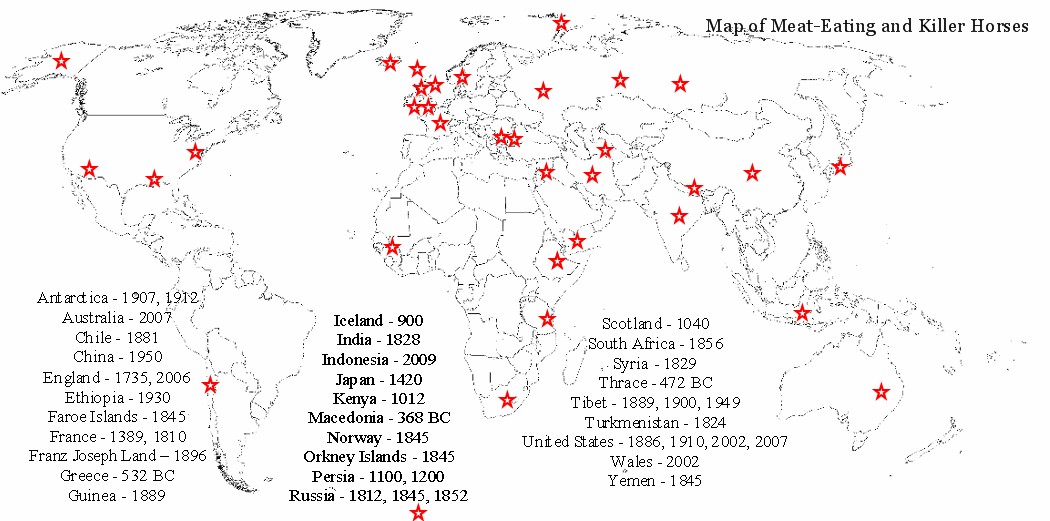
Deadly Equines, one of the most important books of our era, puts to rest these myths by detailing one horse-commited atrocity after another: The Man Eater of Lucknow, Rysdyk-killer of four, the Blood-Eating Horses of Tibet, Sir Ernest Shackleton's voracious Manchurian Socks, and the unfaithful mares of Kind Diomedes. The Deadly Equines site is full of helpful information on the subject, including a Map of Meat-Eating and Killer Horses, showing exactly where and when horse crimes were committed. For too long communities from Antarctica to Yemen have suffered in silence.
So, to anonymous I say this: sure those big buttery eyes may look friendly, but behind them lurks the cold calculating mind of a killer, waiting to strike. A horse will kill you for no reason, just for sport. If a storm is boiling on the horizon, strike fast, strike hard, strike before the horse strikes you. If you find yourself hesitating, just remember how Diomedes met his end.

Sunday, September 4, 2011
Hagrid

Here at COACISSW we generally adhere to a strict no cutting-open-humans-and-crawling-inside-to-survive-a-storm-in-the-wild policy. However, in the timeless words of Spock just before he ventured into the lethally irradiated engineering room of the starship Enterprise, "The good of the many outweighs the good of the few, or the one."
Now imagine you are trapped in the Forbidden Forest, a massive storm--possibly natural, possibly the work of He-Who-Shall-Not-Be-Named--is brewing on the horizon. Acromantulas are closing in and the Arania Exumai spell isn't working to hold them back. And there, at your side, is Hagrid: twice as tall and five times as wide as the average man. His barrel-like chest cavity capable of sheltering your entire party for the duration of the storm.
Plus, he's half giant, so he isn't really a human at all.
Hagrid is friendly and softhearted. Use these qualities against him. Begin to cry, bemoaning your approaching demise. Tell him of all the things you wish you had done, the mountains you would have climbed, the tournaments of wizardry you would have won, the animals you would have treated more kindly, the man or woman you would have kissed. Ask him for a hug.
Sneak your blade into your sleeve and wrap your arms around his neck (be sure to get them under all that hair). As he's squeezing and comforting you, draw out your blade and jam it into his throat with all your strength. This first cut is crucial--Hagrid is quite strong. If you don't wound him terminally with the first strike he'll shake you free and stomp you to dust. Be sure to sever the carotid artery.
There will be fountains of blood. Leap out of the way. Let him tire himself out staggering around trying to staunch it. Ignore his pleas for mercy and his bellows of "Why? Why?" When he collapses, roll him onto his back, slice open his chest, remove his big warm heart, and crawl inside. The acromantulas will leave you alone safely inside their beloved friend, and the storm will pass.
Saturday, August 27, 2011
Hurricane Irene! Emergency Post!
This is our moment people! An apocalyptic swirl is hurtling up the eastern seaboard carving a swath of death and destruction. Three people are already dead. Hundreds of millions more will probably follow. Thirty foot waves, crippling rain, and 100 MPH winds that turn every lawn ornament into a hurtling death missile are coming for your family. The hurricane is the size of Europe, but unlike Europe it's actually threatening. It's every man, woman, and child for themselves.

An 'expert' on CNN just advised everyone to get to their safe room. He's a damn fool. Room's aren't safe. What holds them together? Nails. Razor sharp steel blades just waiting for the moment a hurricane frees them from bondage so they can ravage you and all those you love. Get out of your house! Get out of your apartment! Get outside before it's too late!
Our only hope is to cut open an animal and crawl inside to survive the storm in the wild.
For over a year I've been compiling a list of animals suitable for cutting open and crawling inside to survive a storm in the wild. Grab your blade, consult the list, and get out there. Personally, I've been filling my NYC building's patio with trash for the past hour. The rats are already starting to come. I hope to kill a hundred or so of them to create a safe, warm, nail-less shelter from which to weather this bitch Irene.

Tuesday, August 23, 2011
Chickenosaurus
Good news on the UPADFPMBSPA front today. Jack Horner, the white-haired scientist who gets everybody killed in Jurassic Park, has announced that he's creating a chickenosaurus!
"This is all about attempting to satisfy the aspirations of 6th graders (and children of all ages) and bring back dinosaurs," he writes. Ah the whimsy of an aging megalomaniac! It's so refreshing in this age of 'no you can't hatch your alligator bird because of ethical concerns.' Yes I can! Horner says.

I'm on the record supporting any and all UPADFPMBSPA research. Create them, hatch them, wait for a storm, and slice 'em open, is my opinion. My only concern is that we end up with something adorable like the allifrog.

It's painfully obvious to anyone who's spent time tromping around in the woods lately that there aren't enough vicious beasts with man-sized chest cavities roaming around. The cities are even worse--full of fat people bloating in the sun, surrounded by pigeons. We're going soft, America. Politicians would be wise to take notice and surreptitiously fund the work of the great Dr. Horner. If a couple velociraptors get loose in DC next fall it will certainly take people's mind off the economy.
Saturday, August 20, 2011
120 Pound Rat (This Damnable Epoch)
The economic constraints of this damnable epoch forced me to relocate to a soul-sucking urban shit-center, dampening my connection to the wild survivalist cause of cutting open an animal and crawling inside to survive a storm in the wild. I've spent a year in a concrete wasteland ducking into liquor stores to survive storms. I thought there was nothing but drifters to cut open, and then an article caught my eye.
A 120 pound rat (apparently it's proper name is a capybara, but a rat is a rat) was found in a wastewater treatment plant outside Paso Robles, in Central California. A sewer rat large enough to cut open and crawl inside. The very thought had me rushing home to sharpen my blade.
Running through the street, I noticed several manhole covers and realized that every one is a portal to a wild subterranean kingdom, rife with sliceable beasts. A perfect haven in the event of apocalyptic storms or nuclear fallout. I was tempted to clench my knife in my teeth and leap down, sunny afternoon be damned.
I did some more research and, judging by this video, once you catch a giant rat subduing it shouldn't be a problem.
The lesson here, my friends, is that no matter where life takes you it is possible that you will have to cut open an animal and crawl inside to survive a storm in the wild, and when that time comes, the animal you need will be there. Whether it's lurking in the sewer or leashed to your neighbor's porch. Have faith. Don't hesitate. Remain strong of heart and quick with blade.
Friday, October 29, 2010
Reverend Joseph Goiffon, Hero

The nip of fall is in the air and off on the horizon the darkening clouds gather, plotting cataclysmic hailstorms, squalls, and blizzards. Yes, my friends, winter storm season is upon us. The lazy debauch of summer with its sickening golden hue is a mere memory. Nights are lengthening, flowers are dying, and rodents are scurrying for their rodent holes. Oh, happy day!
Along with the triumphal changing of the seasons, a sensational true story--a most fulfilling scrap of history, a 16 oz ribeye of knowledge--arrived on COACISSW's doorstep courtesy of friend-of-the-blog GregLog. It's a tale of survival and redemption. A man of God facing the raw power of nature and emerging with three of four limbs.
It takes place in 19th Century America: a time when lonely pilgrims braved the raging snows of the high plains with nothing but a horse and their steely will for company; a time when men's brows were bushy with virility and their lips were thin with resolve; and a time when fiery-spirited settlers of the frontier cut open animals and crawled inside to survive storms in the wild. Put yourself there, dear reader. Let your mind travel back to those simpler days. Feel the itch of your woolen long johns and the weight of the knife on your belt. Test your voice: it booms with strength. Gather your eyebrows together and let the bristles connect--how bushy they are! Peer out from beneath them. Make your gaze as flinty as a bear trap. Fill your powerful lungs with crisp clean prairie air and read on, my friends, read on.
"In late August of 1860 Father Joseph Goiffon received a letter from the Vicar General requesting him to travel to St. Paul and to meet with him. Father Goiffon was disturbed by the summons because he feared that he would not be able to return to Pembina (his parish in the great survivalist state of North Dakota) before winter. He left Pembina quickly by oxcart train and arrived in St. Paul in September. The train was to return to Pembina during the first week of October. Father Goiffon thought that he would be ready to return with his friends but he was delayed. He left St. Paul a few days later and hoped to join up with the oxcart train. On November 1 he reached the Great Salt River beyond the present City of Grand Forks and spent the night with other travelers who were encamped there. They urged him to wait until the rain would stop. The winter cold was also beginning to set in. But Father Goiffon was anxious to reach his parish and went ahead by himself on the horse which he had purchased while in St. Paul. The rain turned to snow and quickly both horse and man became hopelessly lost. The horse died in the bad storm, and TO SAVE HIS OWN LIFE THE PRIEST CUT OPEN THE CARCASS AND CRAWLED INSIDE. When Father Goiffon was found he was still alive but one leg was badly frozen."
-from The Michel Houle Family of Centreville, by Bruce Houle (Croixside Press)
Again, big thanks to GregLog for sharing the above text and image.
Monday, October 4, 2010
Taking a Political Stand
Generally, when I sense politics approaching I reach for my blade. I live by the rule of the jungle and the only taxes I pay are are the scraps of meat I'm too full to eat after a fresh kill. I don't support either party or follow the issues (except when education comes up I make sure to mention how negligent our schools are in teaching proper trap-setting and lair-making techniques.)
However, after reflecting on the grizzly-bear-sized sloth and the giant-whale-eating whale, I'm prepared to come out and take what I believe to be an important political stand: I fully support any and all using-prehistoric-animal-DNA-found-in-preserved-mosquitoes-to-bring-said-prehistoric-animal-back-to-life research.
I've looked at the issue carefully from all sides. I watched Jurassic Park three times. I spoke to several amateur zoologists. And every which way I look at it, the benefits far outweigh the risks. Sure, the thought of a ten ton T Rex ravaging Manhattan is frightening, but it would be a tremedous learning moment for the legions of city dwellers who have forgotten the potency of mother nature's wrath. And think of the countless lives that will be saved from storms in the wild by the new bounty of massive chest cavities.
I hope you will join me. Write your senators. Approach them aggressively. Corner them and make sure they understand the importance of using-prehistoric-animal-DNA-found-in-preserved-mosquitoes-to-bring-said-prehistoric-animals-back-to-life (UPADFPMBSPA). Whichever party presents the stronger UPADFPMBSPA bill will certainly have my vote this fall and will probably win the day in these sharply divided times.
Together we can dramatically improve humanity's chances of surviving a storm in the wild.
However, after reflecting on the grizzly-bear-sized sloth and the giant-whale-eating whale, I'm prepared to come out and take what I believe to be an important political stand: I fully support any and all using-prehistoric-animal-DNA-found-in-preserved-mosquitoes-to-bring-said-prehistoric-animal-back-to-life research.
I've looked at the issue carefully from all sides. I watched Jurassic Park three times. I spoke to several amateur zoologists. And every which way I look at it, the benefits far outweigh the risks. Sure, the thought of a ten ton T Rex ravaging Manhattan is frightening, but it would be a tremedous learning moment for the legions of city dwellers who have forgotten the potency of mother nature's wrath. And think of the countless lives that will be saved from storms in the wild by the new bounty of massive chest cavities.
I hope you will join me. Write your senators. Approach them aggressively. Corner them and make sure they understand the importance of using-prehistoric-animal-DNA-found-in-preserved-mosquitoes-to-bring-said-prehistoric-animals-back-to-life (UPADFPMBSPA). Whichever party presents the stronger UPADFPMBSPA bill will certainly have my vote this fall and will probably win the day in these sharply divided times.
Together we can dramatically improve humanity's chances of surviving a storm in the wild.
Friday, September 24, 2010
Grizzly-Bear-Sized Sloth
Do you ever get the feeling life was better one and a half million years ago? I do.
Today, southern Los Angeles is a wasteland of strip malls, amusement parks, and fast food restaurants. To survive in the wild there all you need is $7 and no soul. But, one and a half million years ago this was the home of the grizzly-bear-sized sloth.
Imagine, if you will, wandering through the "moist and lush" Irvingtonian period, lost somewhere between Riverside and Upland, armed with nothing but a broadsword, hacking through ferns as an epic storm roils on the horizon.
You are seeking shelter. You are pitting your wits against the cold steely will of Mother Nature. Your resolve is as firm as your well-muscled torso. And, what do you see, hanging from a tree, fast asleep in its warm woolly hide? A sloth the size of a grizzly bear. Just waiting, waiting, to be cut open and crawled inside to survive a storm in the wild.
Monday, August 16, 2010
Whale
As Dunncle Sam noted in one of his insightful comments about using smaller animals as bait to attract larger animals which you can cut open and crawl inside to survive a storm in the wild, "whales are the 'white whale' of any COACISSWer." Their massive chest cavity, protective layer of blubber, and structural stability make them nature's greatest gift to the stranded survivalist. I suspect that even after the storm abates and the singing of birds can be heard in the trees, one would be tempted to wile away a few more hours inside the noble beast. However, like most truly great things, whales are elusive.
Thus, the primary way a whale is useful to a survivalist is if it's already beached. Whales generally perish in prolonged battles with giant squid (see below for a helpful illustration tattooed on some dude's arm) and sometimes wash up on land in the turbulent hours preceding a storm. But Poseidon is fickle. I urge you not to spend your final minutes 'neath the darkening sky waiting for him to deliver you a whale. Pursue a land beast, but keep an eye to the sea. Hope is the survivalist's most powerful tool.
Hunting one down with merely the knife and floaties I bring on every expedition is a daunting task indeed. Whales are nearly impossible to catch in their own habitat. Though we are both mammals, their swimming ability is far more advanced than ours. Many times I've spotted a whale and leapt into the ocean only to lose it in the ensuing chase.

Sunday, August 15, 2010
Penguins

The main thing to beware of, when cutting open penguins and crawling inside to survive a storm in the wild, is whimsy. Penguins are very whimsical creatures. They wear suits. They toddle around, waggling their heads back and forth. They like to slide down hills. It's easy to get carried away and lose focus--focus necessary for survival. Instead of dragging your penguin fort to a protected area like you should as the storm approaches, you start thinking how funny it is that penguins wear suits and you're wearing a suit of penguins. Then you make a comical gesture or two with a flipper, pretending you're at a cocktail party with George Plimpton and you just said something tremendously witty. Next thing you know you're ignoring the storm altogether, sliding down a hill and BAM--struck by lightning. Game over.
Thursday, August 12, 2010
Selecting a Blade
The second most important tool to bring into the wild (after a steely will) is a quality blade. Loyal readers will have noted a disparity between the sizes of blades used to cut open an animal before crawling inside to survive a storm in the wild. Simon, from The Last Crossing, drove his "sixteen-inch blade into the horse's chest" and used it to saw "the belly down to the legs." Essentially he unsheathed his pirate sword and went to work, hacking and sawing. Bear, on the other hand, used a slightly overgrown pocketknife, valuing precision over brute force as he separated the camel's innards from the camel.
Whenever I embark on an expedition I'm faced with my own conflicting desires for a blade small enough to hurl end-over-end at trees and large enough to wave through the air with a satisfying swish swish. But, as the good people at Survival Topics note, "Choosing the right survival knife is more than an exercise in individuality--your very life may hinge upon its proper selection."
In general, I suggest a full tang, drop point blade approximately six-inches long that has been tested to cut through airplanes and oil drums (knife manufacturers presumably test on these items because of the large number of consumers who slice their way into and out of airplanes and oil drums each year.) The Becker BK10 is a good example. Fallkniven also makes an excellent model. But, ultimately, the choice is yours. Your knife should make you happy and confident, whether you're wandering the aisles of your local grocery store, secure in the knowledge that you could slice that can of chili clean in half, or if you're stranded in the wild, a storm brewing, surveying the carcass of a moose for an entry point.
Monday, August 2, 2010
Giant Catfish

As an American, I've long underestimated freshwater fish. While delicious, the trout and salmon that populate our rivers are small and floppy.
So it was with awe that I viewed the above picture. The giant catfish is truly a behemoth of the stream. Growing up to ten feet long and weighing almost a ton, they are ideal to cut open and crawl inside to survive a storm in the wild. I'm already planning an ill-prepared trip to the Mekong during monsoon season.
However, no sooner do I learn of this great fish's existence, than I learn that it's endangered. The Chinese government plans to dam up the Mekong to feed their insatiable lust for 24 hour discotheques and laser gloves. The giant catfish is to0 large to go over the dam (though I wonder if perhaps it could just smash through) and would not be able to spawn.
We at COACISSW need to stand together to protect this fish (and what I have to assume is a truly spectacular spawning process). As I noted in the giant whale-eating whale post, too many of the best animals to cut open and crawl inside to survive a storm in the wild are already extinct.
Not one more! I say.
I've been angry with the Chinese government for the past few years because of how scared they made me of the Olympics, but this really crosses the line.
But there's hope. They won't be able to dam the river if the river is full of Americans. Bring your boats, jet boats, jet skis, submarines, hover boats, knee boards, fishing gear, spear guns, air rifles, Bud Light Lime, beads, American flag bikinis, and classic rock mixes. Let's turn the Mekong into the Havasu of the east. No need to pack any food, there will be plenty of catfish to go around.
And if a storm comes up, just cast your line into the water and wait for sweet slippery salvation.
Sunday, July 25, 2010
Falkor the Luckdragon

Luckdragons elongated bodies allow them to swim through the air. Covered in scales and fur, they remain in constant motion, wriggling like a snake when they fly.
This elongated body also makes them an ideal candidate for cutting open and crawling inside to survive a storm in the wild, particularly if you are stranded with a large group of children. Only three or four adults can fit inside lying down, however, ten to fifteen children can form a standing line in the beasts lengthy chest cavity.
Falkor in particular is trusting of human children. Thus, if you get lost taking a class of kindergarteners to search for Uyulala the Southern Oracle, and a storm that may or may not be the work of the evil sorceress Xayide is rolling in from the north, have one of them summon Falkor.
With luck, he will find you, and when he does, his luck will run out. Use a long serrated blade to saw him open from chin to tail. Work fast, this will be a traumatic moment for the kids. Consider distracting them by pretending that a rock in the distance is the werewolf Gmork coming to steal their souls.
After the incision is made, remove the guts and herd the children inside. The storm will abate and Xayide will pass over you none the wiser.
A note of caution: children love luckdragons. They might try to avenge Falkor's death. Be particularly wary of a shy bookish boy named Bastian. He has a magic amulet and gets a little crazy.
Friday, July 23, 2010
Honey Badger
The Guinness Book of World Records named the honey badger the world's bravest animal. After watching the above video, I've decided it's just as idiotic as Guinness's other records, like most pirate garbed people in one place or longest leg hair. Sure, honey badgers are brave but they're stupid brave. Brave like punching the biggest guy in the bar just because he's the biggest guy in the bar or eating a jar of expired mayonnaise because your bros dared you to.
It's a classic case of New Jersey brave. Honey badgers snarl around being greasy and picking fights with everyone. They're the guidos of the animal kingdom, making them particularly satisfying to cut open and crawl inside to survive a storm in the wild.
As with real guidos, there's no reason to fight them face to face. Simply wait for them to eat (or drink) something poisonous and pass out. In this case, track the honey badger until it eats a puff adder. Then, when it's out cold in a deathlike fetal position, much like the guy who ate the expired mayo, you can take your time cutting it open and crawling inside.
Thursday, July 22, 2010
Wednesday, July 7, 2010
Lake Monsters
Debate over the existence of lake monsters continues to rage in the academic community. Zoologists spend most of their careers traveling from lake to lake, sitting in small boats late at night, studying dark shapes in grainy photographs, and interviewing strange villagers with terrible secrets.
After spending the Greatest Non Jesus Related Day of the Year at a lake, I can report once-and-for-all that they do exist because I saw not one, but TWO lake monsters. I was out on the dock. It was late. I was surrounded by empty cans of Bud Light Lime and spent explosives, thinking happy thoughts about cavernous chest cavities, when I saw a large ominous shape rising out of the water in the distance. A second later I realized its mirror image was rising out of the water just a few feet to the right. I saw a long neck, a huge body, and I got the distinct impression of fangs.
Once an animal has been discovered, the next logical step is to cut it open and crawl inside to survive a storm in the wild. I scrabbled around the dock desperately searching for something to fire at it but all our fireworks were used and I'd left my gun on a park bench somewhere. When I turned back, the lake monsters were gone.
Cutting open a lake monster and crawling inside to survive a storm in the wild is not going to be easy. Even with modern technology like tasers, rocket packs, and laser gloves, they are elusive. But if anyone can do it, it's an American. We walked on the moon. We nuked Godzilla. We created Michael Jackson and then destroyed him. We can do this. The hunt is on.
Wednesday, June 30, 2010
Giant Whale-Eating Whale
Today is a sad day here at COACISSW. With the discovery of the Giant Whale-Eating Whale we were once again reminded that many of the most ideal animals to cut open and crawl inside to survive a storm in the wild are extinct. Woolly mammoths, tyrannosaurs, brontosaurs, and dragons are all gone while rats, weasels, ferrets, and other essentially useless rodents thrive. I sometimes feel like a survivalist needs a time machine to truly test their mettle.
Obviously, the best way to catch it would be to convince it that you're a sperm whale and then, when it comes at you jaws agape, hurl a boulder down its throat. After it chokes to death, cut it open, hop inside, and weather the storm in the comfort of a Giant Whale-Eating Whale.
The Giant Whale-Eating Whale raged through the seas 13 million years ago, devouring other whales and everything else that stood in its path. There was nowhere to hide. Other whales lived in fear, unlike today when they swagger around at the top of the food chain like huge floating Vin Diesels.
The Giant Whale-Eating Whale's skull was ten feet long and packed with razor sharp foot long teeth. Meaning you wouldn't even need to cut it open. You could just crawl right into its mouth. Not that you would. Because that would make you the kind of person that chooses a condo over a log cabin or a Prius over a big American truck with balls hanging off the hitch.

Monday, June 28, 2010
Art
Normally I'm not a fan of art, but when it reminds me of cutting open an animal and crawling inside to survive a storm in the wild I make an exception. These illustrations by Paul Revie offer a good, if slightly over-whimsical (again:beware the penguins!), reminder of the joyful possibilities of spending time inside a wild animal.


Friday, June 25, 2010
Moose
Moose and hippos are nature's killing machines. If Mother Nature were to take out a hit on you, she would send a moose. Moose will stomp you just to watch you die.

On the other hand, the vastness of their chest cavity is nearly unmatched among land animals (whales, of course, being cream of the crop chest-cavity-size-wise), their bulbous snouts make an excellent spot for keeping snacks or babies warm and dry, and, between the months of June and August, they are chock full of moose milk. These factors make them ideal candidates for cutting open and crawling inside to survive a storm in the wild.
Weigh your options carefully before tangling with a moose. Are there several tender fawns nearby? A couple hundred marmots? A bewildered elk? Or any other animal that wasn't specifically designed to crush your face with its giant pendulous hooves? If not, the best way to catch a moose is to tame a wolf pack and sick it on the moose. As you can see in the illustration below, a well-trained wolf pack can easily confuse and take down even the biggest, angriest bull moose.
If you don't have a wolf pack, go for the nose. Moose noses are so sensitive that the pain of a nose wound can paralyze the animal. Thus a truly deft survivalist could bring the great beast down with a single knife throw.
With any luck, you'll spend the storm safe and dry inside nature's killing machine, sipping moose milk like a Russian prince.

Subscribe to:
Posts (Atom)